DREAMS: The Ministries of Untruth.
The story and the photograph were shared on Facebook. It was moving but I didn’t believe it. I don’t know who wrote it. Perhaps it was generated by AI. I’m quoting it in full because it’s a great example of a problem that we need to talk about:
The Story
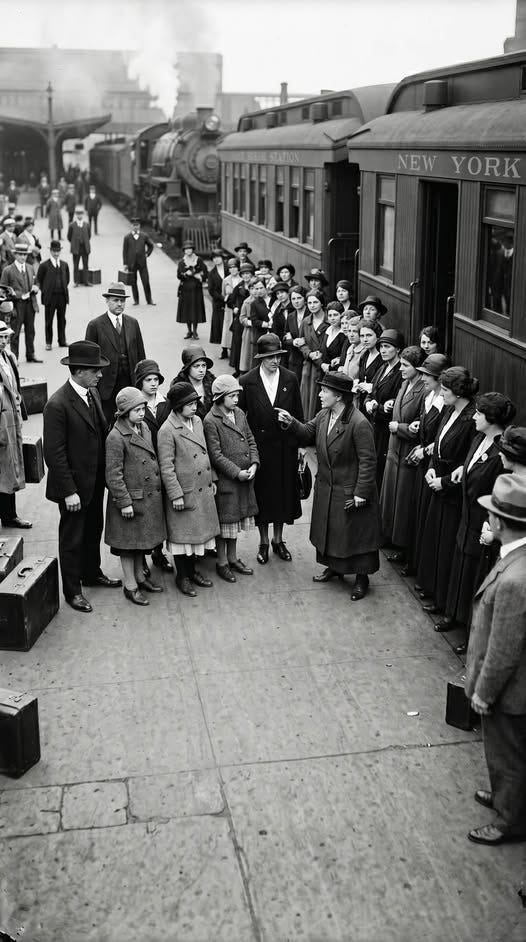
“Seven visibly pregnant girls between the ages of eleven and fourteen were being escorted onto a train in South Station when one woman in the crowd suddenly screamed:
“THOSE ARE CHILDREN! WHERE ARE YOU TAKING THEM?”
And that single shout changed everything.
It was September 22, 1920.
Most people at the station had barely noticed the group moving quietly through the platform — seven young girls led by two men and three women toward a train bound for a place called “St. Mary’s Home for Wayward Girls” in upstate New York.
At first glance, it looked official.
Respectable.
Organized.
But one woman saw something others missed.
Catherine Walsh, fifty-two years old, stopped walking the moment she saw the girls.
They were tiny.
Frightened.
Several were visibly pregnant.
And they looked far too young to understand where they were being taken.
Mrs. Walsh immediately stepped forward and demanded answers.
“Why are pregnant children being taken to New York?”
One of the accompanying women calmly replied that the girls were “unwed mothers” being sent to a rehabilitation home.
But something felt wrong.
Mrs. Walsh walked directly to the girls themselves and asked quietly:
“Are you married?”
Five of the pregnant girls reportedly whispered yes and showed wedding rings.
Then one trembling eleven-year-old began crying.
“They told my parents I have to go there after my baby comes,” she sobbed. “But I heard they take the babies.”
That was the moment everything changed.
Mrs. Walsh turned toward the growing crowd and shouted:
“THESE ARE CHILD BRIDES BEING TRAFFICKED! SOMEONE CALL THE POLICE!”
Within seconds, women across the platform reacted instinctively.
Mothers.
Workers.
Travelers.
Complete strangers.
More than thirty women reportedly linked arms and formed a human chain in front of the train doors, physically blocking anyone from boarding.
The escorts demanded they move.
The women refused.
Passengers stopped to stare.
Railway workers shouted.
Tension spread across the station as the girls stood frozen between fear and confusion while strangers protected them with their own bodies.
And still, the women would not move.
Not until police arrived.
The confrontation delayed the train long enough for authorities to begin questioning everyone involved.
What investigators allegedly uncovered shocked the city.
The so-called “home for wayward girls” was reportedly operating as a system of exploitation where young mothers were separated from their babies — babies who were allegedly adopted out for money — while the girls themselves were kept as unpaid labor for years.
When authorities raided the facility, they reportedly discovered dozens more young mothers living under similar conditions.
All seven girls from the train platform were taken into protective custody.
The men identified as their “husbands” — some allegedly decades older than the girls themselves — were arrested.
And the women who formed that human chain became unlikely heroes.
Years later, the youngest girl, who had been only eleven years old that day, reportedly reflected on the moment that saved her life.
“I was eleven and pregnant, being taken to a train that would separate me from my baby,” she said. “A stranger on the platform saw us and shouted, ‘Those are children!’ Within seconds, thirty women formed a human chain blocking the train. They wouldn’t move until police came.”
“One woman’s shout,” she said, “and thirty women standing together changed everything.”
And maybe that is the most powerful part of the story.
Not just the horror.
But the courage.
Because history changes in moments like that — moments when ordinary people decide they will not look away.
A woman noticed.
Other women believed her.
And together, they stood between vulnerable children and a future no child should ever face.
Sometimes bravery is not grand or planned.
Sometimes it is simply refusing to move when something feels wrong.”
The Historical Reality
I was touched by the story. Young defenceless girls on their way to unjust incarceration, a single voice speaking out for them and a wall of women assembling in response to defend them. A story well told, but a story that is a lie. A Google search using the terms ‘Mrs. Catherine Walsh and St. Mary’s Home for Wayward Girls’ could only find references on social media, LinkedIn, Facebook, Threads.
The historical reality of the institutionalised abuse of unmarried mothers by state and church is documented:
The most infamous example of this is the Magdalene laundries in Ireland:
“From the foundation of the Irish Free State in 1922 until 1996, at least 10,000 (see below) girls and women were imprisoned, forced to carry out unpaid labour and subjected to severe psychological and physical maltreatment in Ireland’s Magdalene Institutions. These were carceral, punitive institutions that ran commercial and for-profit businesses primarily laundries and needlework. After 1922, the Magdalene Laundries were operated by four religious orders (The Sisters of Mercy, The Sisters of Our Lady of Charity, the Sisters of Charity, and the Good Shepherd Sisters) in ten different locations around Ireland …
“The last Magdalene Laundry ceased operating on 25th October, 1996. The women and girls who suffered in the Magdalene Laundries included those who were perceived to be ‘promiscuous’, unmarried mothers, the daughters of unmarried mothers, those who were considered a burden on their families or the State, those who had been sexually abused, or had grown up in the care of the Church and State. Confined for decades on end — and isolated from their families and society at large — many of these women became institutionalised over time and therefore became utterly dependent on the relevant convents and unfit to re-enter society unaided. “
https://jfmresearch.com/home/preserving-magdalene-history/about-the-magdalene-laundries/
I also found official records of forced adoption from Australia:
https://www.dss.gov.au/forced-adoption
and the UK:
https://publications.parliament.uk/pa/jt5803/jtselect/jtrights/270/report.html
A search for ‘Forced Adoption’ in Wikipedia reveals the historical and global extent of state and culturally endorsed abuses of the human rights of pregnant women and girls.
https://en.wikipedia.org/wiki/Forced_adoption
There is clearly an underlying historic abuse that the Facebook story references . But the story parasitises on that history rather than retells it. This, I believe, is wrong.
Ministries of Untruth
In Orwell’s ‘1984’ Winston Smith works for the Ministry of Truth, whose function was to adjust the historical record to fit the narrative that ‘the Party’ was promoting. I think that what is happening with fictionalised histories like the one I shared is that there is a blurring between fiction and fact that degrades confidence in both so that we are left, not with clear categories of truth and fiction, but with narrative that has official or popular endorsement and narrative that does not. We could call this a pollution of the well of history. In this context historiography becomes a necessary science and one that is necessarily opposed to the ‘Ministries of Untruth’ to give them their proper title.
The disturbing thing about Orwell’s Ministry of Truth was not merely that it lied. States and institutions have always lied. The deeper horror was that our perception of reality became unstable because records, memory, language, and public consensus were continually rewritten. Winston’s task was not simply censorship but epistemic management, the administration of what would be perceived as reality.
The modern problem is in some ways subtler and perhaps more dangerous because it is decentralised. Instead of a single Ministry of Truth, we have:
- emotionally charged narratives,
- AI-generated plausibility,
- and the commodification of attention.
In that environment, the criterion quietly shifts from:
“Is it true?”
to:
“Does it resonate?”, “Does it hold our attention?”, “Does it serve the narrative?”
Once that happens, history becomes politicised, moralised and monetised rather than investigated. The same may be said of journalism — the reporting of what is happening today. This can equally be fictionalised to serve the interests of state, political and commercial interests.
It would be easy to declare that “nothing is real”, or “the truth is unknowable”, but I don’t think that we can afford to do that. The ‘ministries of untruth’ exist not only to tell us lies but to make us doubt our ability to know what is true. And truth is the ultimate power of those without political power. Truth may be difficult to find but perhaps it can be found through the application of historiography as a democratic science and through reclaiming our own Dialogue, Reflection, Ethics, Awareness, Meditation and Storytelling (DREAMS) as part of the art of community.