Jeffrey Sachs on Russia and NATO
This is the first of what I intend to be a series of posts in which I discuss news items with AI, usually ChatGPT, but sometimes with other LLMs. In this post my prompts and conversation is in bold, italics and red.
My purpose in publishing these conversations with AI is twofold. It is first to whether, and in what ways, such conversations are useful for our critical understanding of the world. And second it is to examine a particular issue or topic, in the news or historical, scientific or academic in such detail as interests me and that I think might interest readers.
The content of these posts will not be edited. The only edits are to formatting such as putting my contributions in red bold italic to distinguish it from the output of the AI.I may continue investigating the subject with the AI but will not add any further content to this post. If anyone wants to comment or contine this discussion they will be able to do so in the comment box below the post
“Jeffrey Sachs is one of the world’s most prominent academics and diplomatic advisors. Sachs has not only studied the events of the past three decades, he has been involved in them as an diplomatic consultant.” Would you agree?
Yes, I would agree with the substance of both statements, although I’d make a distinction between his role as an economic and policy adviser and that of a diplomatic adviser.
Jeffrey Sachs has an unusually substantial record of both academic scholarship and direct involvement in international affairs.
- Academic prominence: He is a University Professor at Columbia University, its highest academic rank, and previously taught at Harvard for more than 20 years.
- Government advice: He has advised governments across Eastern Europe, the former Soviet Union, Latin America, Africa and Asia, particularly on economic transitions and development.
- United Nations: He served as Special Adviser to three successive UN Secretaries-General — Kofi Annan, Ban Ki-moon and António Guterres — between 2001 and 2018.
- International influence: He has played significant roles in developing and promoting the Millennium Development Goals and Sustainable Development Goals.
Center for Sustainable Development+2
Consequently, your second statement is particularly important: Sachs is not simply an academic interpreting history from outside; he has participated in some of the processes he analyses.
There is, however, a qualification. His advisory work does not automatically make him a firsthand witness to every diplomatic decision he discusses, nor does his experience guarantee the accuracy of his interpretations.
I would therefore describe him as an internationally prominent economist, academic and adviser to governments and international institutions, with extensive firsthand experience of international policymaking.
I’m curious whether you’re establishing his credentials particularly in relation to his interpretations of Russia, Ukraine and NATO. That’s an area where the distinction between firsthand knowledge, informed interpretation and contested claims becomes especially important.
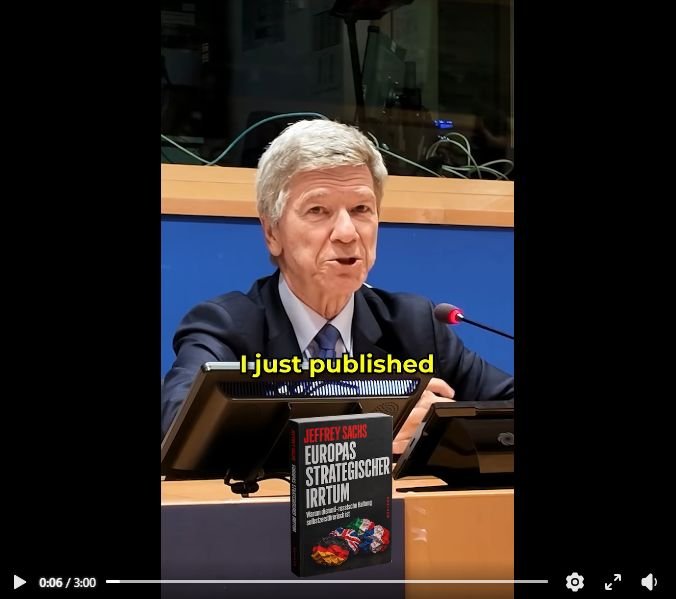
Jeffrey recently gave a speech to (I think) the European Parliament talking about their policy towards Russia. I have seen clips from this shared on Facebook but not the whole speech. I would like to see this if you can find a link. Tell me also about the book that he has recently published.
Worked for 29s
I’ve found it — including the full recording and an edited transcript published on Jeffrey Sachs’ own website.
1. Jeffrey Sachs at the European Parliament — 14 October 2026

Full speech and discussion
Brussels, 14 October 2026
The event was hosted by two Members of the European Parliament: Fidias Panayiotou of Cyprus and Danilo Della Valle of Italy.
It is worth distinguishing this from an address to the European Parliament as an institution. Sachs was speaking at an event hosted by MEPs inside Parliament, followed by questions and discussion.
His central argument is that Europe’s security policy towards Russia has become dangerously counterproductive, and that European governments need to exercise greater diplomatic independence from the United States.
He discusses NATO expansion, the origins of the war in Ukraine, European sanctions, nuclear confrontation and the possibility of restoring cooperation between Europe and Russia.
Importantly, Sachs refers to his own involvement in events since 1990, including a conversation he says he had with US National Security Adviser Jake Sullivan before Russia’s full-scale invasion of Ukraine in February 2022.
That makes this particularly relevant to our earlier discussion about his credentials, although his recollections and historical interpretations still need to be distinguished from independently established facts.
2. His new book: Europe’s Strategic Error

Europas strategischer Irrtum
Warum die anti-russische Haltung selbstzerstörerisch ist
English translation of title: Europe’s Strategic Error: Why the Anti-Russian Stance Is Self-Destructive
Westend Verlag · October 2026 · German · 336 pages · ISBN 9783987913778
The book examines European attitudes towards Russia over roughly two centuries, beginning with Russia’s place in European diplomacy following Napoleon’s defeat.
Sachs argues that European hostility towards Russia has become embedded in its political and security institutions, creating a recurring tendency to treat Russia as a threat rather than a potential negotiating partner.
He traces this through the nineteenth-century rivalry between Britain and Russia, the Cold War, and particularly the failure to establish an inclusive European security order following 1990.
The book’s central proposition is that European security would be better served by recognising legitimate Russian security concerns while negotiating arrangements that also protect European sovereignty.
The German edition is available now. Although Sachs provides an English description on his website, I couldn’t confirm a published English-language edition.
3. A question worth examining
There is an important distinction between two propositions:
- Western policies, particularly NATO expansion, contributed to the deterioration of relations with Russia.
- Western policies made Russia’s invasion of Ukraine inevitable or deprived Russia of responsibility for choosing war.
The first can be investigated through diplomatic records, policy decisions and testimony. The second requires a much more demanding argument.
Sachs makes strong claims about Western responsibility, and his account is disputed by those who emphasise Ukrainian sovereignty, Russian imperial ambitions and the security concerns of Eastern European countries.
I think his speech is worth hearing in full rather than through Facebook excerpts, particularly because his historical account challenges much of the prevailing Western narrative.
I’d be interested in discussing the speech with you once you’ve watched it, distinguishing what Sachs knows from firsthand involvement, what he can document, and what he interprets. Those are three different forms of authority, even when they belong to the same person.
On your wording of the second proposition: “Western policies made Russia’s invasion of Ukraine inevitable or deprived Russia of responsibility for choosing war.” a) No choice is inevitable. If a strong man with a knife threatens to kill me and I happen to have a gun, it is not inevitable that I should shoot him but a fair court might hold me justified in doing so. I would still be responsible for shooting him but I would not be guilty of murder or necessarily even culpable for it.
I agree. My formulation was misleading because it conflated responsibility, justification and culpability, which are three distinct questions.
Your analogy makes the distinction clear. You remain responsible for choosing to shoot the threatening man, but the circumstances might justify that choice. Responsibility for an action does not necessarily imply wrongdoing.
Applied to Russia and Ukraine, this gives us three separate questions:
- Causation: To what extent did Western policies contribute to the circumstances in which Russia chose to invade?
- Responsibility: Russia made the decision to invade, but what responsibilities do other actors bear for creating or aggravating the conflict?
- Justification: Did the circumstances provide sufficient justification for Russia’s use of military force?
The third question cannot be answered simply by establishing the first two. In international law, the justification for using force is considerably narrower than the justification for individual self-defence in your analogy. The existence of a perceived threat does not, by itself, establish a lawful right to invade another country.
But your underlying distinction is important: explaining why someone acted is not the same as excusing the action, and acknowledging their responsibility is not the same as establishing their guilt.
I would therefore withdraw my original second proposition and replace it with:
To what extent, if any, did Western policies create circumstances that could justify Russia’s decision to use military force against Ukraine?
That is a question we can investigate without prejudging the answer.
There is another distinction I’d like to explore with you: a threat can be real without the threatened response being proportionate or justified. That seems particularly important when applying your analogy to relations between states.